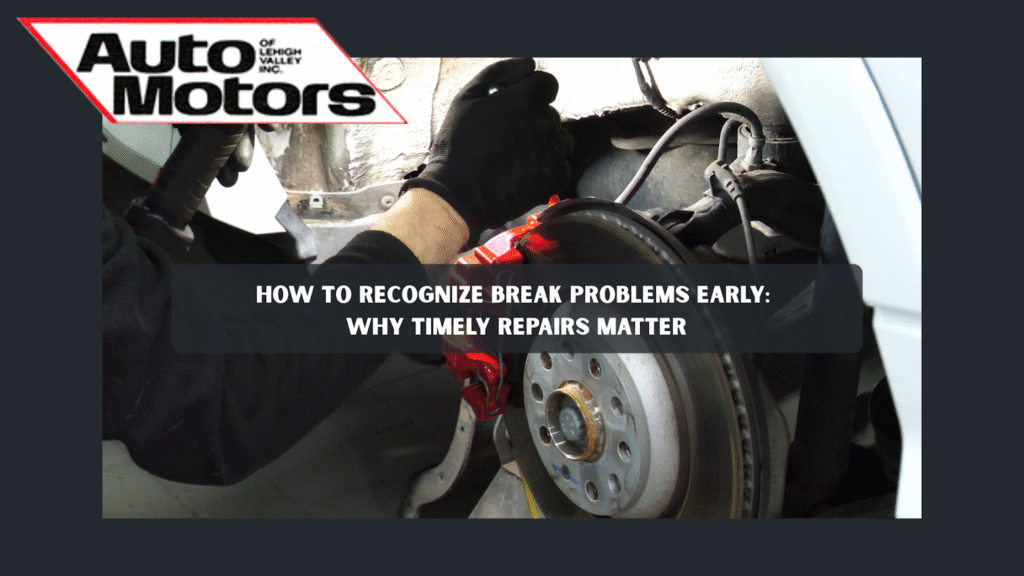
Your vehicle’s braking system is one of the most mechanically complex safety systems on the road. Unlike a burned-out headlight or a low tire, brake problems don’t always announce themselves in obvious ways. They tend to develop gradually, presenting subtle signals that are easy to dismiss until the issue becomes significantly more expensive or even dangerous. Understanding what those signals mean, and knowing when to act, is one of the most practical things a driver can do to protect both their vehicle and their safety.
At Auto Motors of Lehigh Valley, we understand that your time and safety are paramount. Our expert mechanics are ready to diagnose and resolve any brake issues with precision and care. Don’t wait for these symptoms to escalate; contact us today for a thorough brake inspection.
This guide covers the most common brake warning signs, the real-world consequences of delaying repairs, and the preventative steps that keep your braking system performing reliably mile after mile.
What You Need To Look For
Squealing or Screeching During Braking
This is the most frequently reported brake symptom, and for good reason. Most modern brake pads are manufactured with a wear indicator, a small metal tab that contacts the rotor and produces a high-pitched sound when the pad material has worn thin. That noise is intentional. What you’re hearing is a built-in alert designed to prompt replacement before the pad wears down to bare metal. If you hear it consistently when applying the brakes, schedule an inspection promptly.
A Pulsating or Vibrating Brake Pedal
When you press the brake pedal and feel a rhythmic pulsation underfoot, the most likely cause is rotor runout or thickness variation. As rotors wear unevenly or are subjected to thermal stress, their surface becomes irregular. The brake pad can’t maintain smooth, even contact, and that inconsistency translates directly into pedal feedback. Warped or uneven rotors require either resurfacing (if enough material remains) or full replacement.
Vehicle pulling to one side while braking
If your car drifts left or right when you apply the brakes, the braking force is not being distributed evenly across all four wheels. This typically points to a stuck or seized brake caliper, uneven brake pad wear, or a restriction in a brake line. Pulling during braking affects steering control and becomes increasingly dangerous at highway speeds.
A Soft, Low, or Spongy Brake Pedal
A pedal that sinks further toward the floor than normal, or that feels soft and mushy underfoot, usually indicates air in the brake lines or a brake fluid leak somewhere in the hydraulic system. Hydraulic pressure is what translates your foot pressure into stopping force. When that system is compromised, braking efficiency drops in a way that may not be apparent until you need to stop quickly.
A Grinding Noise When Braking
If squealing has progressed to grinding, the brake pad material has likely worn completely through, and the metal backing plate is now contacting the rotor directly. This causes rapid rotor damage and significantly reduces stopping power. At this stage, what might have been a $150-$200 pad replacement can escalate into a $400-$700 or higher rotor and pad replacement, depending on the vehicle.
A Burning Smell After Driving or Stopping
A sharp, acrid odor after hard braking or prolonged use (particularly on hilly roads) can indicate overheated brake components. Occasional brake heat is normal under heavy use, but a persistent burning smell often points to a stuck caliper that is keeping the brake pad in constant contact with the rotor. Left unaddressed, this accelerates wear, overheats the brake fluid, and can reduce braking effectiveness when you need it most.
The Brake Warning Light Illuminates
Most vehicles built in the last decade have a dedicated brake system warning light. This light activates for a range of reasons: low brake fluid level, a detected imbalance between the front and rear brake circuits, a fault in the ABS (Anti-lock Braking System), or engagement of the parking brake while driving. Any of these warrant a proper diagnostic check rather than simply resetting the light.
The Real Cost of Delaying Brake Repairs
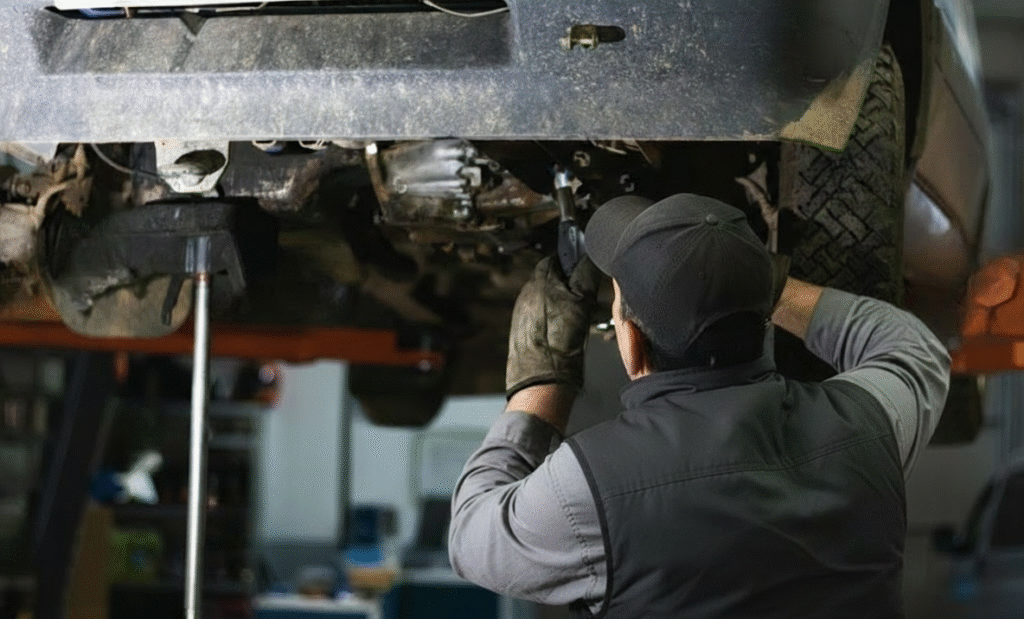
There is a consistent pattern in automotive repair: brake problems that are addressed early are almost always less expensive than those that are allowed to progress. A driver who replaces brake pads when the squealing starts is looking at a straightforward service. A driver who ignores that warning until grinding begins is looking at pad and rotor replacement, and potentially caliper damage as well.
Beyond the mechanical and financial implications, delayed brake maintenance creates real safety risk. Stopping distances increase as braking components degrade. A vehicle with 60% braking efficiency doesn’t stop 40% slower in a proportional way — in an emergency stop scenario, the difference in feet can be significant enough to determine whether a collision occurs.
For fleet operators in the Lehigh Valley region, this is compounded by the operational reality of managing multiple vehicles. A single vehicle sidelined for an extensive brake repair disrupts schedules and can result in costs well beyond the repair bill itself. Regular brake inspections built into a fleet maintenance schedule reduce the likelihood of unexpected breakdowns and keep vehicles on the road. Auto Motors of Lehigh Valley’s fleet services are structured specifically for this kind of proactive management.
Five Brake Inspection Habits Worth Building
Catching brake problems before they escalate doesn’t require mechanical expertise. A few consistent habits can surface problems early and give you enough lead time to schedule a repair on your own terms rather than in an emergency.
- Listen for brake noises (especially on cold starts): During the first few stops of the day, note any squealing, grinding, or clicking that happens only when braking—common signs you may need brake service.
- Look for brake fluid leaks: Brake fluid is clear to light yellow and slightly oily. Puddles under the vehicle—especially near a wheel—can point to a hydraulic brake leak that needs prompt repair.
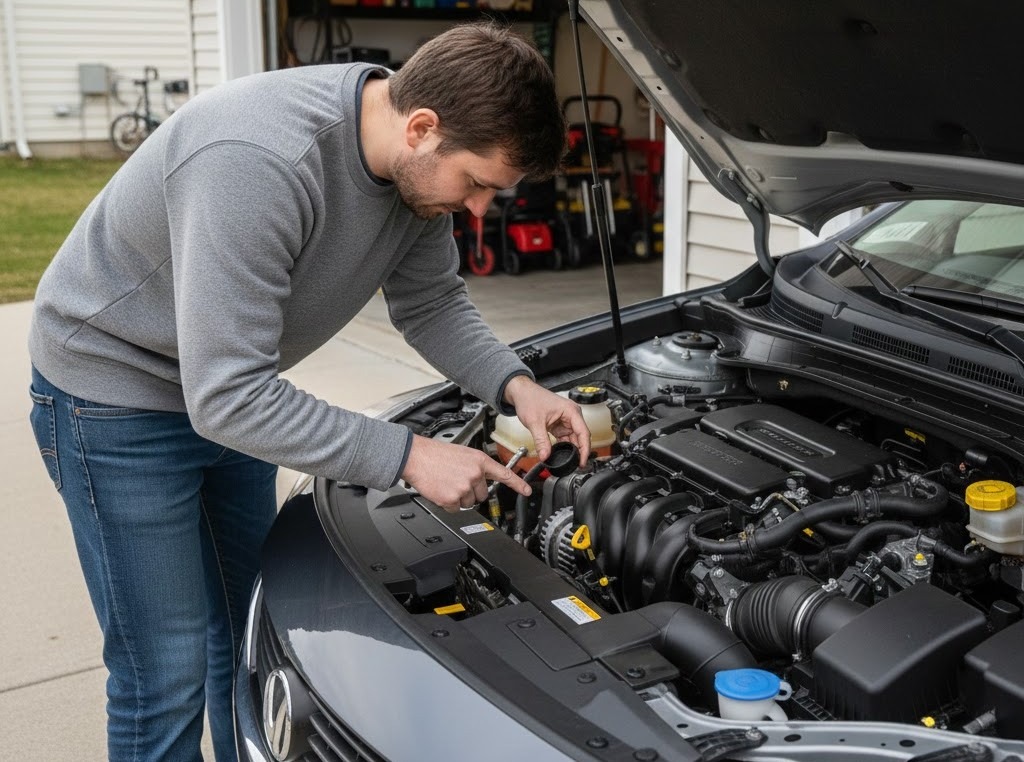
- Check brake fluid level and condition: Fluid should sit between MIN/MAX in the reservoir. Dark or murky fluid suggests contamination and may mean it’s time for a brake fluid flush (many vehicles are commonly serviced around every 2 years / ~30,000 miles, but follow your manufacturer’s schedule).
- Pair brake checks with tire rotations: Tire rotations are a smart time to ask for a quick visual brake inspection.
- Pay attention to braking behavior: Pulling, vibration, longer stopping distance, or new noises are worth noting. If it’s intermittent, record when it happens (highway vs. city, cold vs. warm brakes, wet vs. dry roads) to help diagnose the issue faster. The pedal should feel firm and consistent. If it feels softer, travels farther, sits higher/lower than usual, or needs more pressure, schedule a brake inspection.
Preventative Brake Maintenance: What a Proactive Schedule Looks Like
Reactive maintenance — fixing things after they fail — is almost always more expensive than proactive maintenance. For brake systems specifically, a reasonable preventative schedule looks something like this:
Brake pads on most passenger vehicles under normal driving conditions last between 30,000 and 70,000 miles, though this range varies considerably based on driving style, vehicle weight, and whether the vehicle is used primarily in stop-and-go traffic or highway driving. City driving in areas like Allentown puts significantly more demand on brake components than long highway commutes.
Rotor life is less predictable than many drivers assume. In our work, we see that some new cars still have 70% of their brake pads left at 50,000 miles while, meanwhile, the rotors have already developed a pulsation. In fact, on 95% of the brake jobs we perform, the rotors are in too poor a condition to last through a full second set of brake pads, even when the pads are replaced as soon as the driver sees an indicator that there’s a problem.
Brake fluid should be replaced on a schedule set by the vehicle manufacturer, generally every two years or 24,000 to 30,000 miles. This interval is frequently overlooked because brake fluid doesn’t produce obvious symptoms when it degrades, but contaminated fluid can reduce braking performance and cause internal corrosion in brake system components.
For drivers who regularly tow trailers, haul heavy loads, or drive in hilly terrain, brake components wear faster and should be inspected more frequently. The same applies to fleet vehicles that log high annual mileage. Fleet operators in the Lehigh Valley are encouraged to build brake inspection into their vehicles’ scheduled maintenance intervals rather than treating it as a separate event.
Working with a shop that maintains service records for your vehicle makes it easier to track these intervals accurately over time. At Auto Motors of Lehigh Valley, we document every service visit so that when brake components are approaching the end of their expected service life, we can flag it before it becomes urgent.
Schedule a Brake Inspection at Auto Motors of Lehigh Valley
If any of the symptoms described above sound familiar, or if it’s been more than a year since your brakes were last inspected, don’t wait for the problem to develop further. Contact our team or request a service estimate and we’ll get you scheduled for a thorough brake inspection. We’ve been serving drivers and fleets across Whitehall, Allentown, Fullerton, and the broader Lehigh Valley since 1992.
How a Professional Brake Inspection Works
Many drivers aren’t sure what a brake inspection actually involves, which makes it hard to evaluate whether one is worthwhile. When a technician at Auto Motors of Lehigh Valley inspects your braking system, the process covers all of the following:
Brake pad thickness. Pads are measured and compared against the manufacturer’s minimum thickness specification. Most vehicles require pad replacement when material reaches 3mm or less, though some manufacturers set higher minimums.
Rotor condition and measurement. Rotors have a minimum thickness specification, and a technician will measure current thickness to determine whether resurfacing or replacement is appropriate. Cracks, deep scoring, or heat discoloration may indicate replacement regardless of thickness.
Caliper function. Each caliper is checked to ensure it extends and retracts correctly. A seized or sticky caliper applies uneven pressure to the rotor, which accelerates wear and can cause the pulling or burning symptoms described earlier.
Brake fluid condition and level. The fluid is checked visually and may be tested for moisture content. Contaminated fluid has a lower boiling point, which becomes relevant during hard or sustained braking.
Brake lines and hoses. Physical inspection for cracks, corrosion, or signs of leakage. Rubber brake hoses degrade over time and can develop internal obstructions that restrict fluid flow even when they appear intact externally.
ABS system function. Where applicable, the ABS warning light and any stored fault codes are reviewed as part of the diagnostic process. Our automotive diagnostics team uses current diagnostic equipment to read and interpret brake system fault codes accurately.
Keeping Your Braking System in Good Shape for the Long Term
Brake maintenance isn’t a one-time event. The braking system is in continuous use every time you drive, and its condition changes incrementally over time. Building awareness of what normal braking feels and sounds like for your specific vehicle is one of the best tools available, because deviations from that baseline are often the earliest signal that something needs attention.
Paired with regular professional inspections, that awareness gives you a practical early-warning system for brake problems at their most manageable stage.
Auto Motors of Lehigh Valley has provided brake service, diagnostics, and repair to Lehigh Valley drivers since 1992. Our experienced technicians work on domestic and foreign vehicles, and we’re equipped to service both personal vehicles and commercial fleets. Whether your concern is a specific symptom you’ve noticed or simply a brake inspection that’s overdue, we’ll give you a clear picture of what your vehicle needs without unnecessary upselling.
Contact us today to schedule your brake inspection, or call us at 610-266-9466.